neu-suite
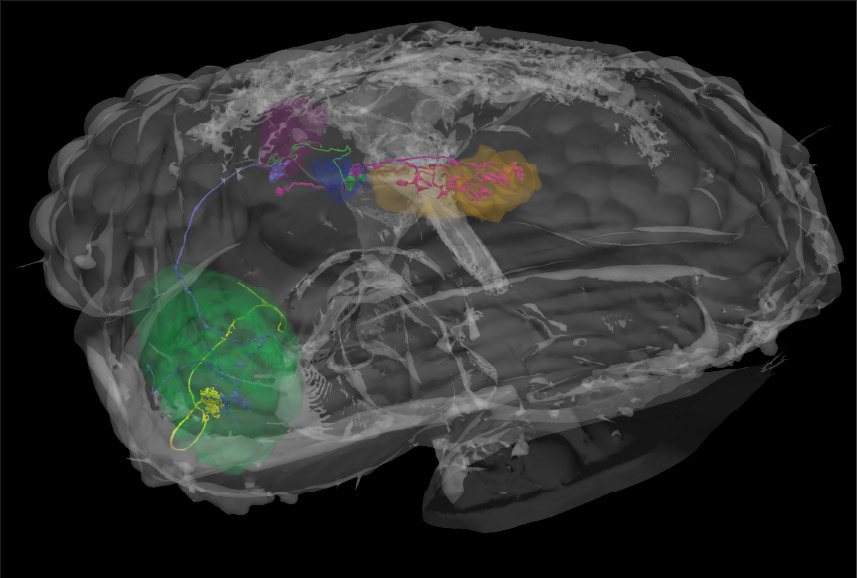
A four-neuron pathway carrying visual information from the eye to the central complex: R7p (yellow) in the medulla, MeTu_MC1b (blue) to the anterior optic tubercle, TuBu_BUs1 (magenta) to the bulb, and TL1a (green) to the ellipsoid body — meshes and skeletons built with these packages from a proofread segmentation.
Python packages for working with large EM volumes, locally or on a SLURM cluster. They are separate repositories with a strict one-way dependency, and the split is deliberate: the substrate that knows how to run work on a cluster knows nothing about electron microscopy, and the layer that knows about volumes knows nothing about meshes or biology.
neu-lib   blockrun  vocabulary (BBox, Frame, Mesh, Skeleton — numpy only)
    ↑         ↑        and the dask/SLURM substrate. Neither knows about the other.
neu-vol             volume I/O: tensorstore backends, storage profiles,
    ↑                  convert / create / write / relabel, source metadata
    ├─ neu-morpho      per-body meshes (vol2mesh) and skeletons (TEASAR)
    ├─ neu-mark        DVID annotations into tables, and on into neuroglancer
    ├─ neu-glance      viewer states, layers, links and shaders
    └─ neu-proc        array processing: filters, label tools, distance transforms
           ↑
        neu-draw      local 3D rendering in a notebook, on pygfx
        neu-eval      comparing a segmentation against a reference labeling
Nothing lower may import from anything higher, and consumers at the same tier do not import each other.
Which one do I want?
You almost certainly want a command, and there are five:
neu-volThe volumes themselves — inspect one, convert a source into a multiscale pyramid, create an empty volume in a known frame and write pieces into it, renumber labels, watch a run.
neu-morphoMeshes and skeletons from a segmentation, published into the same precomputed volume so one neuroglancer layer shows labels, meshes and skeletons together.
neu-markAnnotations out of DVID — synapses and per-body records — into columnar tables, then on into neuroglancer. Choose the bodies by synapse count, and label each synapse with the neuropil it sits in.
neu-glanceAnything a viewer consumes: a shareable link or a state, a layer of your own coordinates, a layer of boxes showing where a sparse volume’s data is. The other three write data and know nothing about neuroglancer.
neu-evalHow good is a segmentation? Variation of information, adapted Rand, matching and completeness against a reference labeling — and a ranked, located list of where the two disagree, which round-trips so you can record that the reference was the wrong one.
Three packages have no command. neu-lib holds the types they all share and blockrun
is the substrate they all run on; neu-draw is a notebook library — it draws meshes,
skeletons and synapse points locally with pygfx, where neu-glance sends a state to a
remote neuroglancer. neu-proc is the newest and the least finished: array-in, array-out
processing functions, with the blockwise machinery that will make them correct across
block boundaries designed but not built.
Start at the cheat sheet — every subcommand on one page
with its synopsis. The CLI reference has the full flag-by-flag detail,
generated from the parsers themselves so it always matches --help.
Calling them from Python instead — from a notebook, or from your own script — is the API reference: every module of every package, parsed from the source.
Using them
API
Guides
- Converting a source into a multiscale volume
- Several small pieces into one frame
- Reading and writing from Python
- A piece is an array that knows where it is
read_piece— the voxels, and everything known about where they are- Transforming without losing the frame
write_piece— back out to a file- Then placing it back into a volume
- Looking at one on the way past
- Checking what you wrote
- What is deliberately not here
- Ground truth: from annotated chunks to meshes
- Viewing the results in neuroglancer
- Rendering locally in a notebook
Tutorials